New Books in July!
What to Say When Your Child Has Big Feelings: 6 Simple Scripts That Actually Help
What to Say When Your Child Has Big Feelings — 6 Parent Scripts Meta description: Stuck for words when your child is worried, angry, or jealous? Here are 6 simple, validate-first scripts to say in the moment — calm, kind, and easy to remember.
Peggy Orr, Ph.D
7/3/20264 min read
Every parent knows the moment. Your child is melting down in the cereal aisle, frozen at the school gate, or crying over something you simply cannot fix — and your mind goes completely blank. You want to help. But the "right words" don't come, so you reach for "you're fine" or "calm down," and somehow it only makes things worse.
Here's the reassuring part: you don't need a perfect speech. Young children settle fastest when a grown-up does two small things, in this order — name the feeling first, then offer one tiny action. Validate, then act. That's the whole method, and it works because a child in a big feeling can't think their way out until their body feels a little safer first.
Below are six scripts for the six moments parents tell me are the hardest. Each one is short enough to remember mid-meltdown, and each ends with a simple tool your child can actually use. Save this page, or screenshot the ones you need most.
What to say when your child is too worried to go in
The first day of school. A birthday party. Swimming lessons. Their feet won't move and their tummy is in knots.
Skip: "You'll be fine." (They don't feel fine, so it lands as if you're not listening.)
Try this instead:
"Your tummy feels wobbly, doesn't it? That's worry. Let's take three big breaths together."
You name the feeling first, then settle the body. A worried child can't reason clearly until the fluttery feeling eases — so breathe with them before you try to talk them through it. Breathe in for three, out for three, three times. The tool: Three Big Breaths.
What to say when your child is mid-meltdown
They're stamping, shouting, "I'm SO mad!" Your instinct is to shush it — but "calm down" almost never calms anyone down.
Skip: "Calm down."
Try this instead:
"You're really angry right now. That's okay — I'm here. Let's stomp it out together."
This isn't permission for the behavior — it's permission for the feeling. You name the anger and give the body a safe job, so the big feeling moves through instead of getting stuck. Five firm stomps, then one big breath, and the heat starts to cool. The tool: Stomp It Out.
What to say when you can't make it better
The toy broke. The friend went home. They are crushed, and every part of you wants to fix it fast.
Skip: rushing to solve it, or "don't cry."
Try this instead:
"You're feeling sad, and I'm right here. Shall we sit together for a minute?"
Sitting with a feeling, instead of rushing to fix it, teaches your child something powerful: that sadness is safe, and that it passes — like clouds moving across the sky. You don't have to mend it. You just have to stay. The tool: Hand on Heart.
What to say when your child is jealous
A sibling got the bigger slice. A friend got the new toy. "It's not fair!"
Skip: "Don't be jealous" or "you should be grateful."
Try this instead:
"It's hard when someone has something you want. That feeling is called jealous, and everybody feels it — even me. Can we say it out loud together?"
In young children, jealousy curdles into shame quickly — "I'm bad for feeling this." Naming it out loud as a normal, universal feeling takes the sting out before it becomes a story about who they are. The tool: Name It Out Loud.
What to say when your child wants to disappear
They tripped, spilled, or got laughed at — and now they want the floor to swallow them.
Skip: "Nobody noticed." (They know that isn't true.)
Try this instead:
"That felt embarrassing, didn't it? It happens to everybody — even me. I'm right here with you."
A child's instinct when embarrassed is to hide. Your calm, steady presence tells them two things at once: this moment is survivable, and there is nothing wrong with them. The tool: The Tiny Smile.
What to say instead of "good job"
They did something all by themselves, and they're glowing. "Good job" is fine — but you can do so much more with the same breath.
Skip: only "good job."
Try this instead:
"You did that all by yourself! How does proud feel in your body?"
Two things happen here. You point them toward the feeling in their body, and you praise the effort rather than the result. That's the quiet formula for raising a child who keeps trying — even when they don't get it right the first time. The tool: The Proud Pose.
The one pattern behind all six
Look back and you'll notice every script does the same two things: it names the feeling ("that's worry," "you're really angry"), and it points to the body before it offers an action. That's not an accident. Feelings live in the body long before children have the words for them — a fluttery tummy, hot cheeks, a heavy chest — and helping a child notice where a feeling lives is often the fastest way to help it pass. Name it, find it in the body, then reach for a small tool. You can use these anywhere, and the more your child hears them, the more they start to say them to themselves.
Where these scripts come from
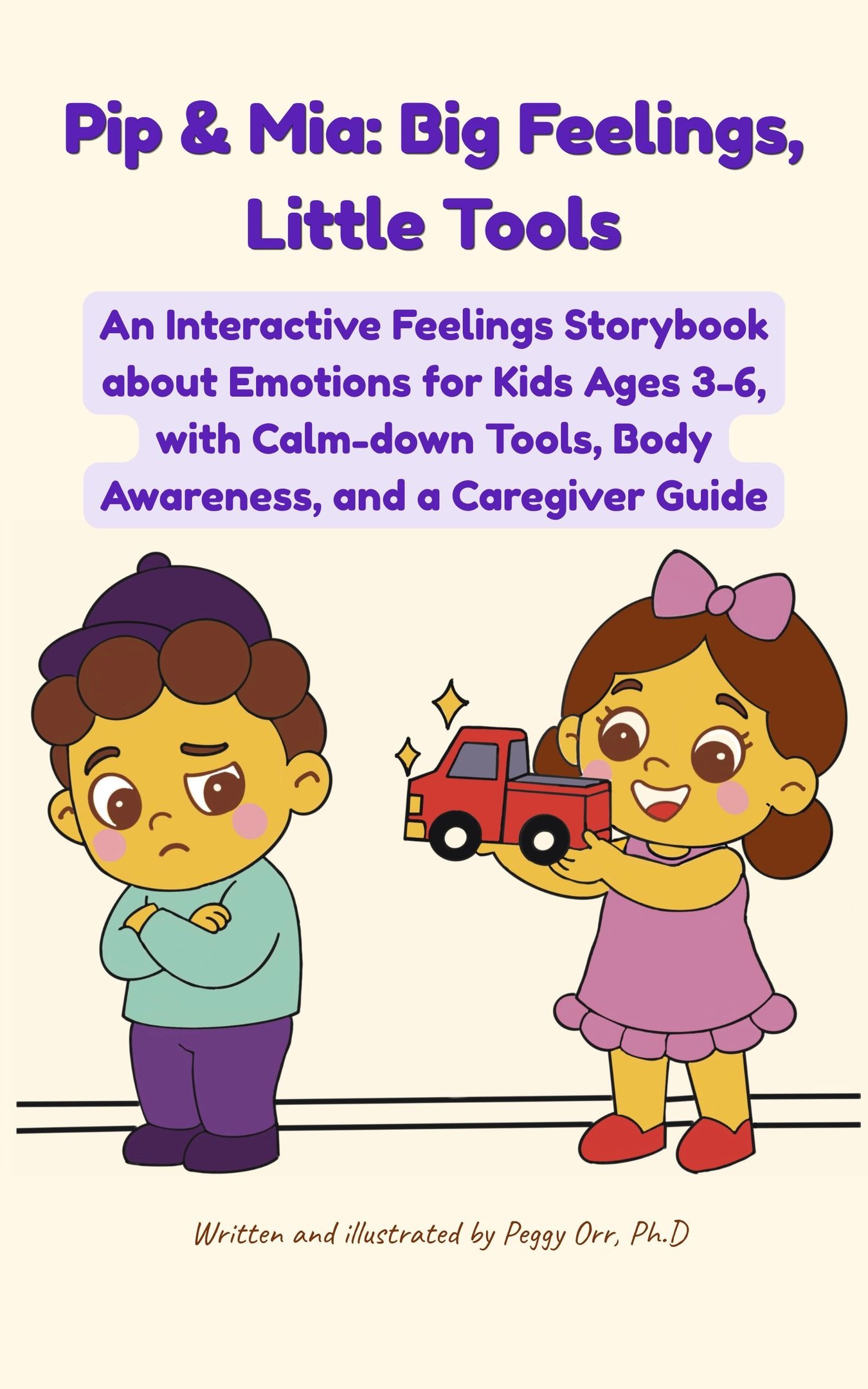
Every script above is pulled straight from Pip & Mia: Big Feelings, Little Tools — an interactive feelings storybook for children ages 3–6. In it, Pip and Mia meet eight big feelings, discover where each one lives in the body, and collect a simple "little tool" for every single one. And on every page, there's a "For the Grown-Up" line — a script just like the ones above — so you're never left guessing what to say.
If you'd like the whole toolkit in one gentle, read-aloud book, you can Pip & Mia: Big Feelings, Little Tools on Amazon: https://a.co/d/08ZIBe2m, or explore the full Pip & Mia Explorer Series at orrdinaryfun.com. Color. Read. Play & Bond.
Written by Peggy Orr, PhD — creator of the Pip & Mia Explorer Series, warm and playful books for curious little explorers.
A gentle note: this post offers general support for everyday big feelings and social-emotional learning. It isn't a substitute for professional medical or mental-health advice. If you're worried about your child's emotional wellbeing, please reach out to a qualified professional.